

Focus Tech Lab: High-Precision AI Strabismus Diagnostic Device with Medical Data Modeling Reduces Detection Costs by 90%
Reported by Sing Pao Financial News - Personal Interview, 5 Aug 2024
Strabismus is an eye disease that frequently occurs during children's growth stages, which can mildly affect appearance and severely lead to amblyopia or loss of spatial perception. The startup Focus Tech Lab, under the Entrepreneurship and Research Center (CEAR) of Hong Kong Education University, has developed a strabismus diagnostic device that integrates artificial intelligence (AI). The machine's diagnostic error value is approximately 4 PD (prism diopter), lower than the mainstream methods' 8 PD to 10 PD, and can save 86% of detection costs.
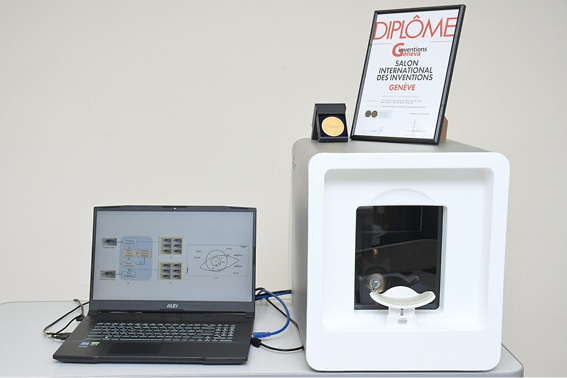 The diagnostic error value of the AI strabismus device is about 4 PD (prism diopter), lower than the mainstream methods of 8 PD to 10 PD.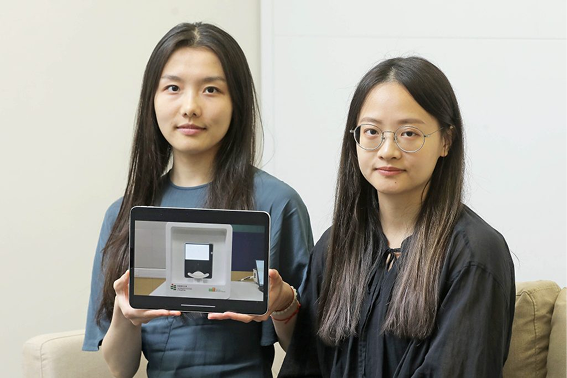
Wang Yanyue (left) stated that she hopes to analyze patients' age, strabismus type, etc., through the AI strabismus device to match the training frequency and intensity; next to her is Nie Fengzhi. (Photo by Huang Junyao)
Story Originally Reported by Hong Kong Economic Journal- Interviews by Wingtong Chow, August 5, 2024
In a significant breakthrough for eye care technology, Operations Director Wang Yanyue of Focus Tech Lab has unveiled the world’s first device that mimics the hands-on examination techniques of physicians to diagnose strabismus. This AI-driven diagnostic tool, which utilizes advanced computer vision technology, captures and records eye movements using infrared lenses, subsequently processing this data through a sophisticated artificial intelligence system.
Wang explains that the innovative algorithm at the heart of the device meticulously analyzes eye structure, detecting and tracking the position of the eyes to provide precise measurements of strabismus. Additionally, the device features real-distance testing, allowing practitioners to evaluate patients' visual performance at varying distances—near, intermediate, and far. Notably, the technology bears similarities to facial recognition systems but is designed to meet even higher accuracy standards.
A Challenge in Imitation
The complexity of this strabismus diagnostic technology is not to be underestimated. Wang articulates that while a proficient programmer might draft the device's software in a month, the real challenge lies in data modeling and the extensive training required to transform the concept into a fully operational tool. To refine their algorithms, the Focus Tech Lab team has diligently partnered with the ophthalmology and optometry clinic at the Hong Kong Polytechnic University during their developmental phase, later gathering data from three leading hospitals in Hong Kong and Beijing.
Acclaimed for its ingenuity, Focus Tech Lab has secured patents not just in Hong Kong, but also in mainland China and the United States. Addressing concerns about potential replication, Wang confidently asserts that the intricate nature of their project makes imitation a formidable challenge, emphasizing that the endeavor took a decade from conception to realization. "Replicating this device would require at least five years," she states emphatically, while also acknowledging the existence of similar products, including a VR-based diagnostic device from an Israeli tech firm, which struggles with higher error margins and lacks the capacity for real-world testing.
The Next Chapter: Effective Treatment Approaches
With the groundwork laid for accurate diagnostics, the next crucial step for Focus Tech Lab is to explore effective treatment methodologies. Wang has shared that the team is currently developing a comprehensive approach that encompasses both eye muscle training and relaxation techniques. Nevertheless, the rollout of personalized treatment options is still some time away.
Wang Yanyue, reflecting on her own childhood experience as a strabismus patient alongside Dr. Fu Hong, an assistant professor in the Department of Mathematics and Computer Science leading the research, recalls her gradual recovery through a simple yet effective exercise of threading beads. The team envisions leveraging similar methods tailored to specific patient needs, adjusting training frequencies and intensities according to age and strabismus type.
Demonstrating a keen awareness of diverse community requirements, the team is not limited to strabismus diagnostics alone. They have also developed “Smart Writing,” a multimodal intelligent handwriting assessment system designed for special education contexts. This innovative system comprises an eye tracker, a camera, and a handwriting pad, capturing various metrics such as posture, eye movement, pressure, writing speed, and quality to assess reading and writing difficulties.
Currently, Smart Writing has not garnered medical certification but is available for trial by various academic institutions. Besides partnering with local universities, the system is also being evaluated at East China Normal University in mainland China. Wang contends that many academic institutions are lacking in such all-encompassing products, underscoring how the team’s developments align perfectly with the pressing needs of educators and students alike.
As Focus Tech Lab pushes boundaries in eye care technology, Wang Yanyue and her team remain committed to advancing not only diagnostic capabilities but also treatment avenues. Their journey reflects the broader narrative of innovation that intertwines scientific advancement with real-world applications, aspiring to make a tangible difference in the lives of those affected by strabismus and beyond.
