
Behind hospital curtains, on the walls of residential care homes, on children's toys in kindergartens, and deep within air conditioning filters, an invisible war never ceases. Pathogens lurk on the surfaces we touch daily, waiting for the next opportunity to spread.
Conventional approaches are facing multiple challenges. Cleaning with disinfectants can only keep pathogens at bay for a short time. The active ingredients in chemical antimicrobial coatings diminish over time, and prolonged use of chemical biocides risks creating "superbugs" resistant to existing treatments. Data from Hong Kong underscores the severity of the issue: the SARS-CoV-2 virus alone has caused 13,000 deaths; approximately 15% of patients acquire infections during hospital stays; and the medical cost per pneumonia-related hospitalisation is approximately US$9,900. In care homes and kindergartens, persistent mould growth and cross-infection remain a recurring nightmare.
Addressing these critical pain points, a Hong Kong-based research team led by Dr. Eric Tung-Po Sze has developed a fundamentally different solution. This technology, named "Protonic Thunderbolt", aims to create an "immune skin" upon the surfaces of buildings and products.
The breakthrough nature of Protonic Thunderbolt lies in its mechanism of action, which is entirely distinct from traditional products. Most antimicrobial coatings on the market rely on releasing chemical biocides like silver ions or quaternary ammonium compounds, whose efficacy wanes over time. In contrast, Dr. Sze's team has developed a polymeric-base coating with non-release antimicrobial active components on the treated surface. When a microorganism comes into contact with this layer, microbial membrane and envelope would be physically ruptured and destroyed—a physical disruption, not a chemical poisoning.
This purely physical mechanism offers three key advantages. First, it presents zero risk of antimicrobial resistance (AMR), a critical global health threat warned by the World Health Organization (WHO). Second, it provides broad-spectrum efficacy against viruses, bacteria, mould, and even AMR superbugs. Third, it ensures long-lasting (> 5 years) activity and solvent resistance, as the active component does not leach away over time. The innovation of this technology has been recognised by the China National Intellectual Property Administration and is currently under patent application.
The efficacy of Protonic Thunderbolt has been validated by multiple ISO standards, demonstrating a 99.99% or greater inactivation rate against a wide range of pathogens. In terms of safety, it has passed the ISO 10993-5 cytotoxicity test, confirming it is non-harmful to human skin and lung cells. It is also resistant to cleaning with alcohol and diluted bleach solutions, integrating seamlessly into standard disinfection protocols.
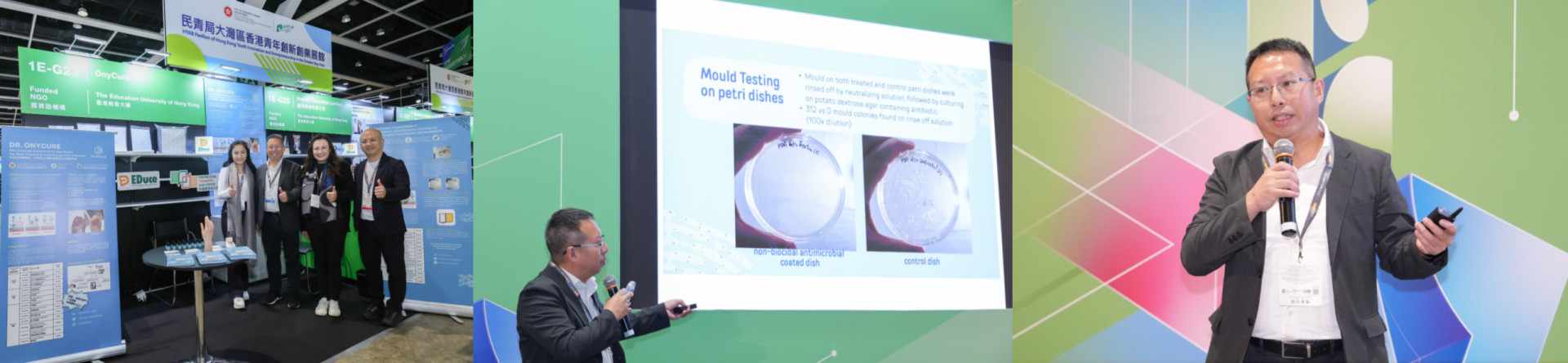
However, the most compelling evidence comes from real-world trials. At a residential care home for people with disabilities, persistent mould on walls was a long-standing problem. The team conducted a one-month controlled test, and the results were striking: mould colonies rinsed from the petri dish treated with Protonic Thunderbolt numbered zero; the untreated control dish, in stark contrast, yielded 30,000 mould colonies. Tests on air conditioning deflector panels were equally dramatic—the treated surface showed no bacterial or fungal growth, while the untreated surface harboured both.
Recent developments show this technology moving from the laboratory into broader applications. Several prominent local companies have begun trialling air purifier filters incorporating Protonic Thunderbolt technology. From wall paint to air conditioning systems, Protonic Thunderbolt is applicable to a wide variety of substrates, including plastic, metal, non-woven fabric, wood, and concrete.
From a market perspective, comparable products typically offer protection for less than six months. Protonic Thunderbolt, however, provides protection for over five years, at a competitive price point. With Hong Kong's experience of the COVID-19 pandemic raising public awareness of infection prevention, and the World Health Organization declaring antimicrobial resistance one of the top ten global public health threats facing humanity, the market potential is significant.
The core principle behind Protonic Thunderbolt is to shift the focus of infection control from "reactive cleaning" to "proactive protection," empowering the environment itself to actively inhibit pathogens. By using a physical mechanism to overcome the challenge of AMR, it offers a more sustainable solution for public health. As the team states: Be prepared for the next pandemic, safeguarding the environments we inhabit every day with excellent efficacy, long-lasting protection, and an affordable price.
Dr. Sze is a familiar face in the media, leading a research team deeply engaged in the field of antimicrobial materials for many years, with their findings regularly published in international scientific journals. Recently, Dr. Sze and his team participated in the world's largest annual invention exhibition—the International Exhibition of Inventions Geneva—presenting their innovation to the world and being awarded a Silver Medal. He is also currently pursuing a PGDE programme at The Education University of Hong Kong, and his project and company are among the start-ups incubated by the Centre for Pre-incubation and Outreach (CPO). Congratulations on his remarkable achievement at the exhibition. Potential investors and corporate partners interested in collaboration are cordially invited to connect for mutual success.
Related Stories:
- 鳳凰網:https://health.ifeng.com/c/8rZN1wZyIaF
- 新浪網:https://news.sina.com.cn/sx/2026-03-18/detail-inhrhttu3945208.shtml
- 健康一線:https://www.vodjk.com/news/260317/1972777.shtml