

— Illuminating Perception for the Hard of Hearing with Haptic Technology
"I believe touch is a forgotten language."
When I first met Wang Jinhua, a PhD candidate at the Education University of Hong Kong (EdUHK)’s Faculty of Education and Human Development, she was demonstrating a palm-sized haptic device. Affixed to her wrist, the device sent subtle vibrations across her skin as she simulated scenarios like "steps ahead" or "someone approaching from the left" --- like a rhythmic sequence of "tactile code." It’s hard to imagine that this core driver, who infuses technology with "warmth" to make it accessible, does not come from a computer science or engineering background. Instead, she is a researcher deeply rooted in educational psychology and a passionate practitioner of dance. Her entrepreneurial story is a vivid example of how a non-technical background can empower technological innovation, with a single mission: to help the hard of hearing (and visually impaired) perceive the world more freely through touch.
From "Bodily Cognition" to "Haptic Innovation": The Unexpected Synergy of Interdisciplinary Experience
Wang Jinhua’s academic and life journey had long laid the groundwork for her entrepreneurship.
Her research focuses on "computational thinking and creativity in adolescents," but it has always revolved around a core question: How do humans perceive and learn? In educational psychology classes, she explored how "different senses influence cognitive efficiency"; in labs, she analyzed how "non-verbal signals motivate learning." Beyond academia, she is a gold medalist in international dance competitions: the "body rhythm" of traditional Chinese dance taught her to communicate with space, the "improvisation" of contemporary dance helped her understand the flexibility of physical expression, and the "precision" of ballet shaped her attention to detail. Most notably, to better connect with friends who are hard of hearing, she proactively learned Hong Kong Sign Language. Through the rise and fall of her fingertips, she gained a profound insight: Body language can transcend the barriers of sound and become a bridge for culture and emotion.
"Back then, I often wondered if the body understands the world better than we think," Wang says with a smile. Her entrepreneurial turning point came at an industry exchange event, where she met the HaptiPal team --- a cross-border group of engineers from Switzerland and Guangzhou. The team was developing dynamic haptic technology to help the visually impaired and hard of hearing perceive their surroundings through tactile vibrations. However, they hit a critical roadblock: How could users quickly "understand" the vibration signals transmitted through their skin? Cold technical parameters (frequency, intensity, rhythm) felt like random vibrations to ordinary people, let alone for people with disabilities who rely on touch for information.
Just as the team was stuck, Wang’s interdisciplinary experience suddenly "clicked": Linguistics taught her that "signals need logical ‘grammar’"; educational psychology reminded her that "user cognitive habits must be respected"; dance and sign language helped her grasp "the body’s sensitivity to rhythm and direction." "It was like a light turning on," she recalls. "I realized I couldn’t write code --- but I could ‘teach the body to understand the world.’" She joined HaptiPal as a core founding member, taking charge of haptic language design and user psychology modeling.
Using "Educational Thinking" to Shape Technology: Giving Vibration Signals "Warmth"
After joining the team, Wang’s first move was to "relocate" the lab to communities of the hard of hearing and visually impaired.
She brought early prototypes to deaf service centers in Hong Kong and schools for the visually impaired in Guangzhou, sitting beside users to carefully record their feedback: "This vibration is too fast—I can’t tell if it means ‘obstacle ahead’ or ‘someone calling’"; "If vibration moves from the inside to the outside of the wrist, can that mean ‘direction from left to right’?" These on-the-ground insights became the cornerstone of her "TactileFlow™ Haptic Coding Engine."
She infused linguistic logic into the technology:
- She compared "vibration frequency" to "tone in language" --- low frequencies for "warning information" (e.g., obstacles) and high frequencies for "guidance information" (e.g., direction);
- She designed "vibration rhythm" as "pauses in sentences" --- short, rapid vibrations for "emergency signals" and long, spaced vibrations for "routine guidance";
- She even incorporated the "spatial positioning" concept from sign language, assigning vibrations on different body parts (wrist, arm, waist) to "environmental information at different distances" (nearby obstacles, approaching people, distant road conditions).
"It’s like teaching a child to speak," Wang explains. "You start with simple ‘words,’ then combine them into ‘sentences,’ and finally build ‘conversations.’"
To align the technology with user habits, she also applied the educational psychology principle of "progressive learning": Initially, the device only transmitted 3 core signals (obstacle, direction, help), with complexity added gradually as users became familiar. She also designed "tactile memory cards" --- combining images and text --- to help users link "vibration patterns" to "real-life scenarios." One hard-of-hearing user shared: "Before, vibrations made me nervous. Now it’s like someone tapping my hand gently, telling me ‘it’s safe here.’ It’s so reassuring."
This user-centric design gave HaptiPal’s technology "warmth." Lukas, a Swiss engineer on the team, admits: "We used to only care about the precision of technical parameters. Jinhua taught us that good technology must ‘understand people.’ Her non-technical background has become our most valuable competitive edge."
Boundary-Crossing Entrepreneurship: From Roadshows to Clinical Validation
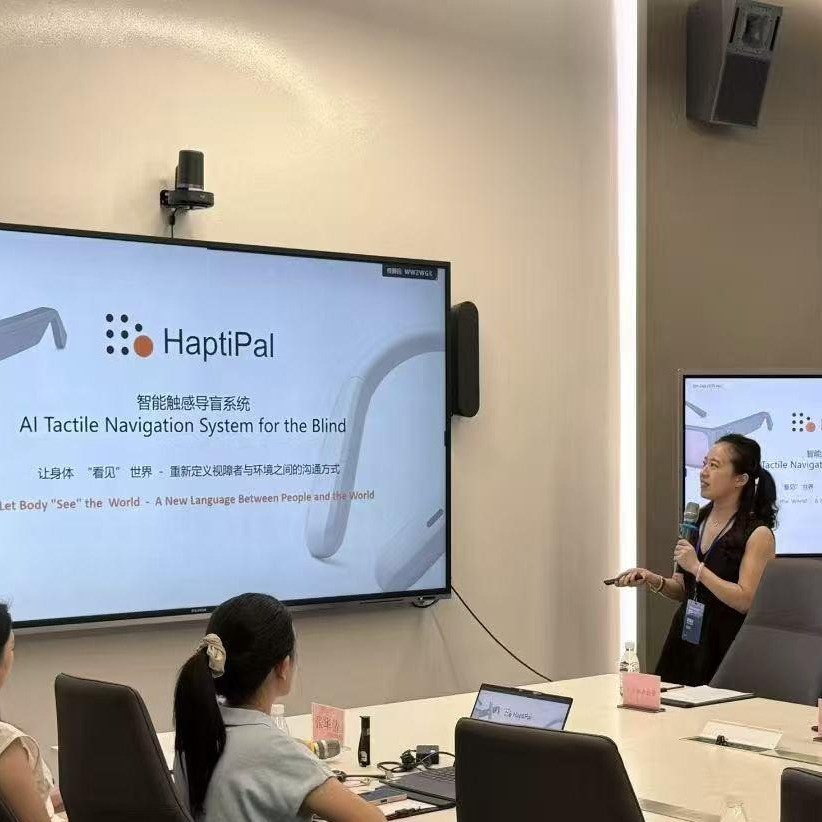
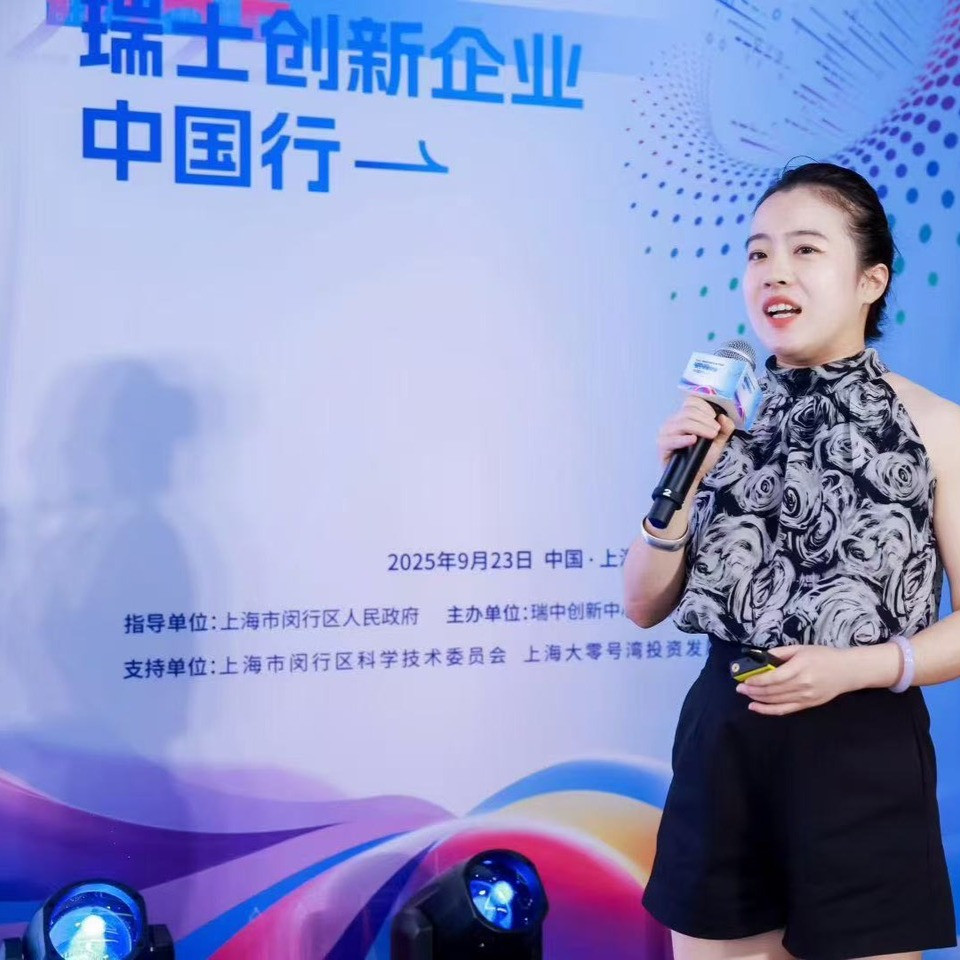
With HaptiPal, Wang’s footprint has spread across Guangzhou, Shanghai, Shenzhen, Kunshan, Wuxi, Zhenjiang... At roadshows in different cities, her "non-technical perspective" always resonates with investors.
Unlike engineers who focus on explaining technical principles, Wang excels at conveying value through stories: She tells how Chen, a hard-of-hearing user, found an elevator independently in a mall using TactileFlow™; she shows how Uncle Li, a visually impaired user, safely crossed a street he once feared walking alone. "Investors ask most about ‘market potential,’ but I want them to see ‘human needs,’" she says. Once, after an investor tested the prototype, he held her hand and said: "You’re not just building a product --- you’re paving a ‘path for people to perceive the world.’ That’s more powerful than any business data."
Cross-cultural collaboration also brought its share of challenges. The team members hail from 2 countries and 5 regions, and differences in time zones and cultural habits often led to communication "bottlenecks" in the early stages: Swiss engineers, pursuing "technical perfection," wanted to conduct several more rounds of lab tests; while colleagues focused on the Chinese market, prioritizing "speed of implementation," hoped to get the product into users’ hands as soon as possible. Wang Jinhua stepped in as a "bridge" --- she applied the "perspective-taking" method from educational psychology, organizing regular team sessions to share "user stories." This helped the engineers see that "delays in technology could affect users’ daily lives," and also enabled the market-focused colleagues to understand that "technical rigor is a form of responsibility to users." "True innovation isn’t about avoiding conflicts," she summed up, "but about finding a balance that ‘serves users best’ amid those conflicts."
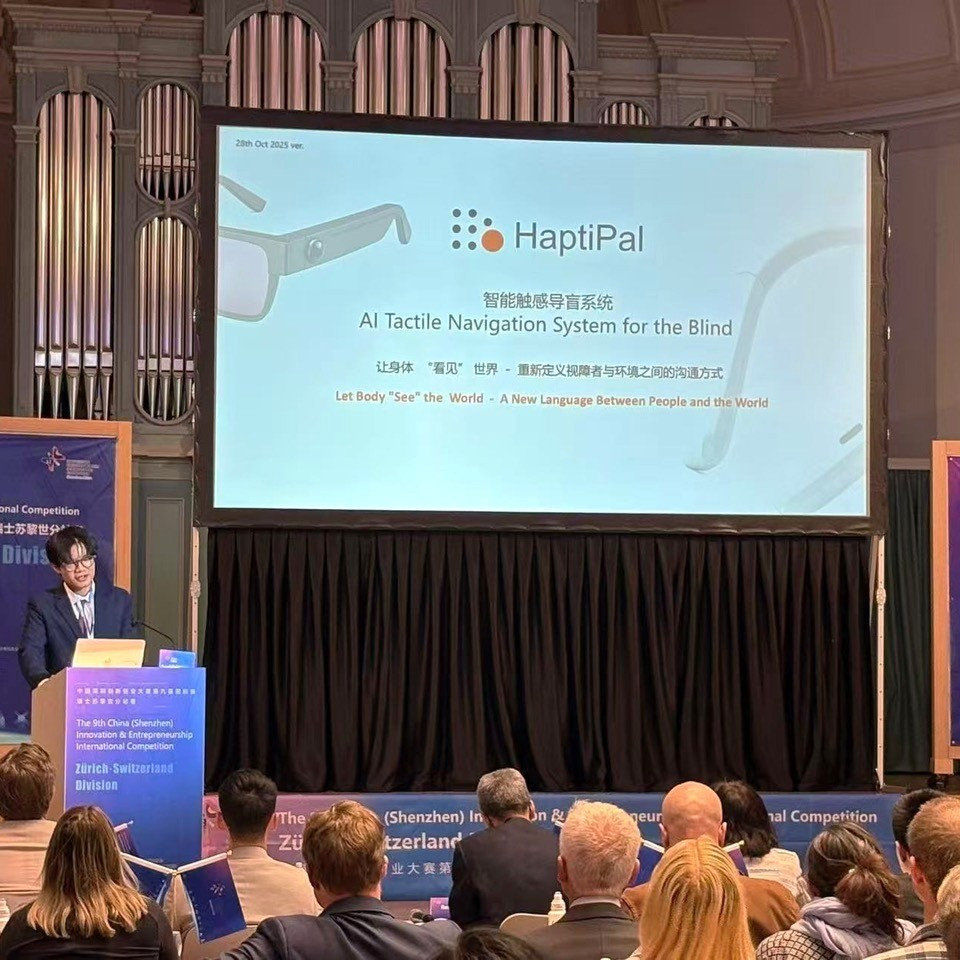
Today, HaptiPal has won first place in the Swiss division of the "Chunhui Cup China-Switzerland Innovation and Entrepreneurship Competition" and been selected for the Hong Kong Science and Technology Parks Corporation (HKSTP) Co-Ideation Program. The team is now fully advancing clinical validation. Wang’s goal is clear and firm: "In the next three years, we want to help our hard-of-hearing and visually impaired friends walk freely and safely through touch --- no longer relying on others for support, no longer fearing the risks of ‘not seeing’ or ‘not hearing.’ They should be able to feel the direction of the wind, the smoothness of the road, and ‘see’ the world in their own way, just like everyone else."
The Educator’s Original Aspiration: Entrepreneurship as "Empowering Education"
Looking back on her entrepreneurial journey, Wang says her experience at EdUHK has always been her "spiritual foundation."
"Education is not just about imparting knowledge --- it’s about empowering everyone to grow in their unique way. Entrepreneurship is the same: We’re not ‘giving’ users a product; we’re ‘empowering’ them to perceive the world." She is pursuing her PhD, where she integrates entrepreneurial insights into her doctoral research titled Cognitive-Affective Dynamics in Computational Thinking and Creativity. When asked, "As an education PhD, why dive into tech entrepreneurship?" Wang always gives the same answer: " Because everyone has the right to ‘see’ the world in their own way. Sound is not the only way to communicate; sight is not the only way to perceive. If touch can be that bridge, I’m willing to spend my life paving this path of perception."
At the end of the interview, the setting sun filtered through the window, illuminating the TactileFlow™ device in Wang’s hand. She pressed a button gently, and a soft vibration spread across her wrist --- it was the signal she designed for "safe arrival," like a quiet "you did it." This entrepreneur, who emerged from the field of education, is using her unique way to help more people "hear" the world’s gentle response.
(Interview by: Centre for Pre-Incubation and Outreach, The Education University of Hong Kong)
